

How much insulation does a Bay Area attic need?
Our usual target is R-38 in the attic. We install any R-value you want, based on your request and what we recommend after the inspection.
That matches ENERGY STAR, which recommends R-38 for an attic that already has 3 to 4 inches of insulation and R-49 for an uninsulated attic, in Zone 3 on its climate map. Most of the Bay Area falls in Zone 3.
What does R-38 mean?
R-value measures how well insulation resists heat moving through it. The higher the number, the better it insulates. R-38 is a rating, not a thickness.
Different materials reach the same R-value at different depths. So R-38 of blown-in cellulose and R-38 of batts look different in the attic, but they are meant to slow heat by the same amount when installed correctly.
How thick is R-38 insulation?
It depends on the product. Every insulation bag or batt package lists the depth needed for each R-value, and that is the number an installer should follow.
For blown-in insulation, the coverage chart on the bag shows the settled depth for each R-value, because loose-fill settles a little after it is blown in. A good installer blows it deep enough to still reach the target after settling. Batts come in set thicknesses, each labeled with its R-value.
How do I check how much insulation I have now?
Look from the attic hatch with a flashlight and a tape measure. You don’t need to climb in to get a good idea.
- Can you see the tops of the ceiling joists? If the wood framing on the attic floor sticks up above the insulation, the layer is thin.
- Is it even? Look for bare spots, low areas and gaps, especially near the eaves and around the hatch.
- Is it clean? Paths, tunnels, droppings or stains mean rodents have been in it.
- How deep is it? Push a ruler gently down to the ceiling below, in a spot you can reach from the hatch.
Never step between the joists; the ceiling below won’t hold you. And if you see droppings, don’t touch them.
Is more insulation always better?
Up to a point. Going from a thin layer to R-38 can make a real difference in comfort. Going far beyond that adds less each time.
An even layer with no gaps matters as much as the number. A thick layer with bare spots, flattened paths or a missed corner lets heat through where the gaps are. That is why we look at the whole attic floor, not just the depth in one spot. If you want more than R-38, we can install it; that is your call, with our honest recommendation.
What about crawl spaces and walls?
Our usual targets are R-19 under the floor in a crawl space, and R-13 to R-15 in walls.
Under the house we use batts, fitted between the floor joists and held up with metal wire supports so they stay against the floor. Attics get the thicker layers, crawl spaces thinner ones. See batt insulation.
Cellulose or batts: which reaches R-38 better?
Both reach R-38 when installed to the right depth. Our most popular is blown-in cellulose, because it fills evenly around wires, pipes and ducts on an open attic floor.
Batts suit attics with clear, even joist spaces. We install brands like Owens Corning PINK fiberglass batts, Knauf EcoBatt, ROCKWOOL Comfortbatt (stone wool), and CleanFiber cellulose (our main one) and Mountain Fiber cellulose. For a closer comparison, see cellulose vs fiberglass.
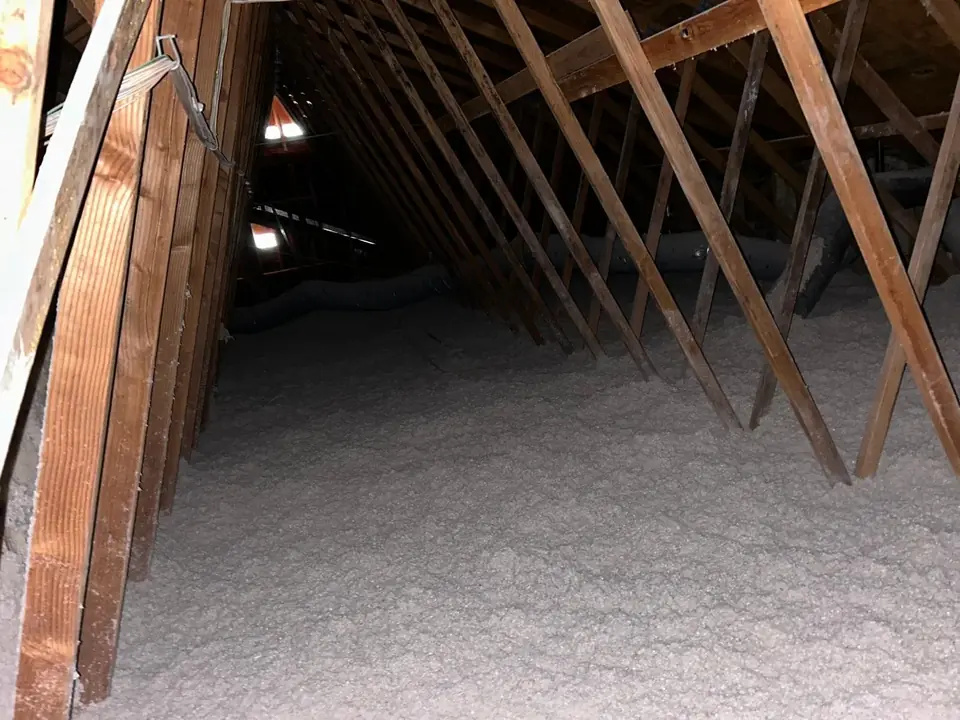
Does my old insulation count toward R-38?
If it is clean, dry and in good shape, yes. New insulation can be added on top to reach the target.
If it is soiled with droppings, wet or badly flattened, it should come out first. Covering it hides the problem without fixing it. Our post on replacing insulation after rats explains how to tell. Removal and sanitation are part of attic cleaning.
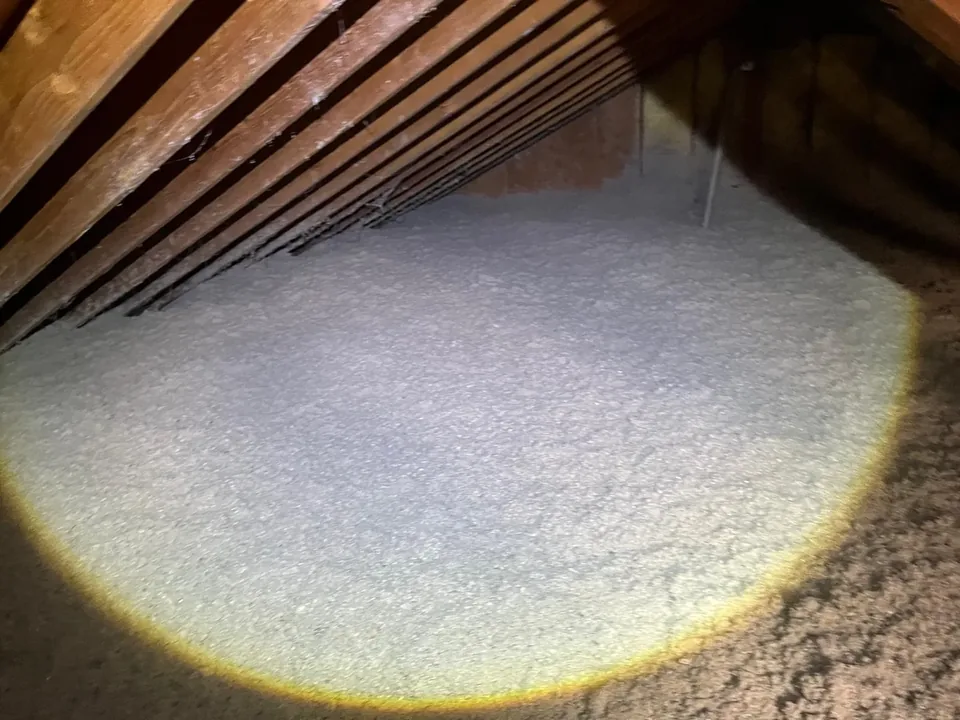
Does attic insulation help in winter too?
Yes. Insulation slows heat in both directions. In summer it keeps attic heat from coming down; in winter it keeps the warmth from your heater from escaping up through the ceiling.
Bay Area winters are mild, but nights can still be cold, and a thin attic layer lets that warmth go straight up. The same even layer works for you all year.
What about the attic hatch and the eaves?
Check both closely. The hatch cover itself is often bare, and the insulation around it gets pushed aside by people climbing in and out.
At the eaves, the roof comes down low and insulation is often thin or missing. It is also where air needs to come in through the eave vents, so a careful installer fills the edges without blocking those vents.
What we see on real jobs
In attics around San Jose, Cupertino and Santa Clara, most homes we inspect have less insulation than they should:
- Thin layers where the joists show through.
- Bare spots near the eaves and around the attic hatch.
- Insulation pushed aside by past electrical, cable or plumbing work.
- Tunnels and droppings from rodents.
Insulation is a one-day job. Book a free inspection or call us. We measure what you have, photograph it, and send a written quote the same day.