

Does old blown-in insulation need to be replaced?
Not just because it is old. Insulation can last many decades. We recommend replacement based on its condition and performance, rather than its age alone.
Blown-in insulation that is clean, dry and deep enough keeps doing its job. What wears it out is damage: rodents nesting and tunneling in it, water from a roof leak, and years of storage boxes and foot traffic squashing it flat. So the real question is not “how old is it?” but “what shape is it in?”
Signs your blown-in insulation should be replaced
From the attic hatch, with a flashlight, look for these:
- Droppings, tunnels or nests. Rodents have been living in it, and the urine soaks in too.
- Stains or a musty or ammonia-like smell. Signs of old leaks or animals.
- Wet or clumped areas. Insulation that got soaked rarely goes back to the way it was.
- Flattened paths and bare spots. Often near the hatch, along the walkways of past repair work, and at the low edges by the eaves.
- Tops of the ceiling joists showing. If the wood framing sticks up above the insulation, the layer is thin.
Don’t climb in, and don’t touch droppings. The CDC says never to sweep or vacuum rodent droppings or nests, because that stirs germs into the air.
Can new insulation be blown on top of the old?
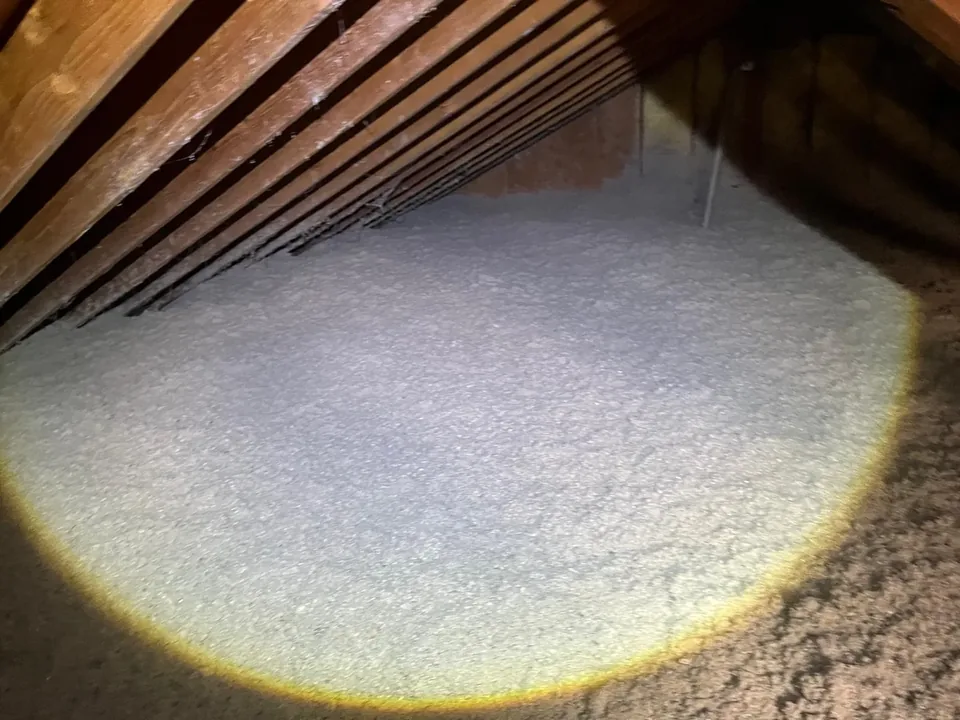
Yes, when the old layer is clean and dry and just too thin. Topping it up is often the simplest fix.
When it is soiled, wet or tunneled through, it should come out first. Blowing new insulation over droppings hides the mess but leaves it there, and the smell with it. If the ways in were never sealed, rodents simply move into the new layer. Our post on replacing attic insulation after rats covers that case in detail.
Doesn’t blown-in insulation settle?
A little, after it is blown in. That is normal, and the coverage chart on every bag shows the settled depth needed for each R-value. A good installer blows it deep enough to still reach the target after it settles.
So a layer that looks a bit lower than on day one is not a reason to replace it. A layer that has been crushed flat by boxes, or pushed aside during plumbing, electrical or cable work, is a different story: those spots let heat through.
Does blown-in insulation work?
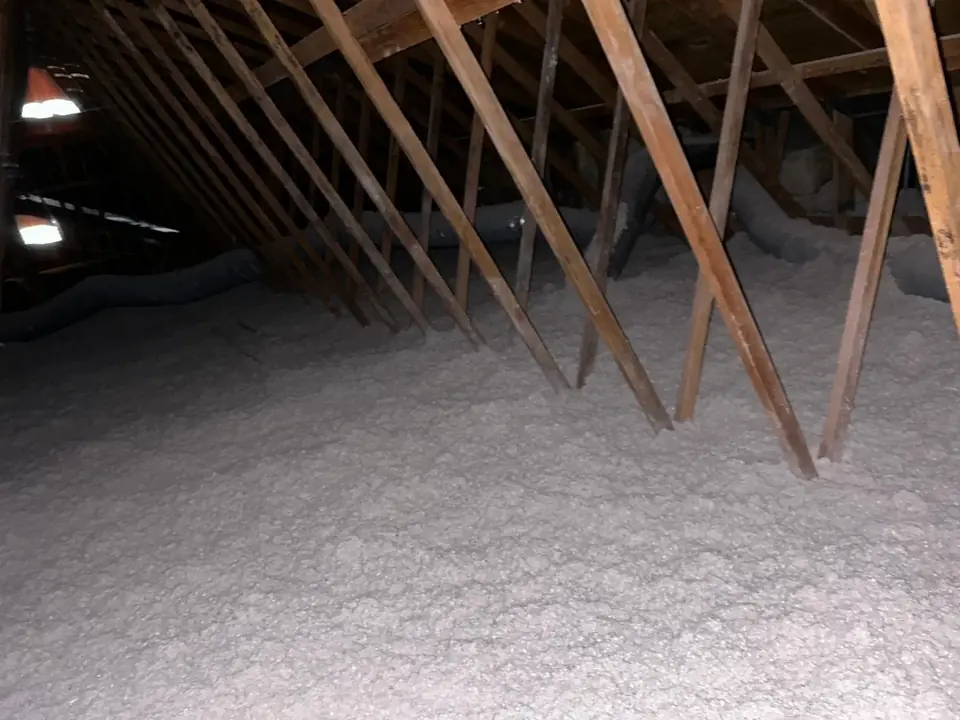
Yes, when it is installed to the right depth and stays clean and dry. Blown-in insulation fills evenly around wires, pipes and ducts on an open attic floor, where batts would leave gaps.
That is why blown-in cellulose is our most popular insulation. Our usual target in the attic is R-38. That lines up with ENERGY STAR's guide to adding attic insulation, which lists R-38 when an attic already has 3 to 4 inches and R-49 when it has none, for Zone 3, where most of the Bay Area falls. We check what you have at the inspection. We install the R-value that fits your home, based on what you ask for and what we recommend at the inspection.
What do you blow in when it is replaced?
Our most popular blown-in insulation is cellulose, and we also install blown-in fiberglass. For cellulose, we mainly install CleanFiber, and sometimes Mountain Fiber.
CleanFiber says it is made from recycled cardboard, with an all-borate fire retardant infused into the fibers, and that it is low dust (cleanfiber.com). All cellulose insulation sold in the US also has to meet a federal flame-resistance standard, 16 CFR Part 1209. We also install batts where they fit better; see cellulose vs fiberglass.
What about the crawl space and the garage?
Blown-in insulation is made for open attic floors. Under the house, in the crawl space, we use batts fitted between the floor joists and held up with metal wire supports, so they stay against the floor. In the garage, batts go in the open wall framing, and in the ceiling when there is a room above.
The same rule applies there as in the attic: fallen, wet or soiled insulation comes out, the ways in are sealed, and new insulation goes in clean. Our usual targets are R-19 under the floor and R-13 to R-15 in walls. See batt insulation and crawl space cleaning.
What does a replacement involve?
- Free inspection. We check the attic, crawl space and garage, and photograph what we find.
- Same-day written quote. Usually within 30–60 minutes of the inspection, with removal as its own line.
- Your home protected. The crew covers the path from the front door to the work areas with drop cloths or plastic sheeting.
- Old insulation out. Removed and hauled away with us, then the attic is sanitized.
- Ways in sealed. Openings closed with galvanized steel mesh, putty and concrete, so rodents can’t move into the new layer. See rodent proofing.
- Fresh cellulose blown in. An even layer across the whole attic floor, to the R-value you chose.
Most jobs take one day. The crew takes before and after photos and sends them to you. Removal and sanitation are part of attic cleaning.
What we see on real jobs
In attics around Milpitas, Fremont and Santa Clara, the problems we find in old blown-in insulation are usually the same, and age is rarely the main one:
- Tunnels, nests and droppings left by rodents.
- Stains from an old roof leak.
- Flattened paths from storage and past repair work.
- Thin, bare spots near the eaves and around the attic hatch.
Not sure what yours needs? Book a free inspection or call 1-408-664-9888. You get photos of what we find and a written quote the same day.